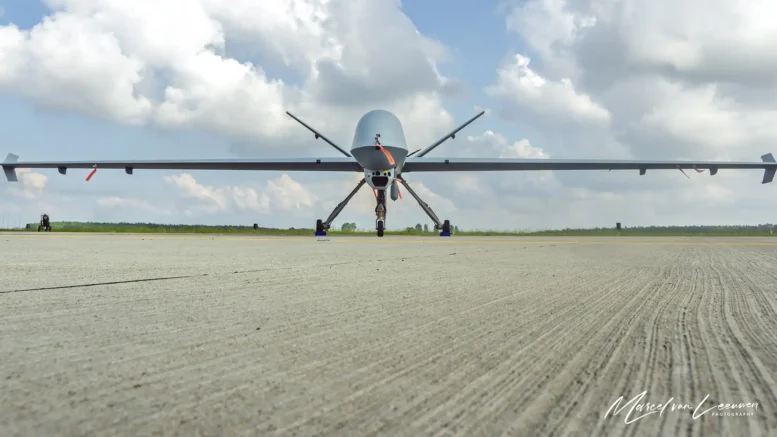
AviationNews – The United States Air Force has announced its intention to field a more affordable, mass-producible successor to the MQ-9 Reaper drone by 2031. This strategic shift is heavily influenced by recent tactical lessons from operations against Iran, where the deployment of large drone quantities and the acceptance of combat losses have become decisive on the modern battlefield.
The development of this next-generation unmanned aerial system follows the MQ-9A Reaper’s prominent role, and subsequent vulnerability, during Operation Epic Fury against Iranian forces. Acknowledging the unsustainability of risking drones that can cost up to $50 million each in heavily defended airspace, the Air Force partnered with the Defense Innovation Unit (DIU) in July to launch the Massed Modular Aircraft (MMA) initiative. This program seeks to design a Reaper replacement that can be built faster, deployed in larger numbers, and treated as an “attritable” asset against layered enemy air defenses.
Technically, the proposed MMA platform must operate at a combat radius of 2,300 nautical miles while carrying at least 2,800 pounds of payload. Modularity is a central requirement; the new aircraft will feature easily swappable sensors, weapons, and fuel configurations. This flexibility allows commanders to strip down the drone and reduce costs when flying into high-threat environments. By shifting toward larger fleets of lower-cost drones, the military aims to maintain constant airborne pressure, forcing adversaries to exhaust expensive anti-aircraft missiles on expendable targets.
“By getting something that’s more modular, we think we could take advantage of an opportunity — if you knew that aircraft was going to operate in a high-threat environment — of taking off those packages that drive that cost,” stated Air Force Chief Modernization Officer Lt. Gen. Christopher Niemi, emphasizing the push for a much lower price point.
Looking ahead, this procurement strategy signifies a permanent evolution in aerial warfare, prioritizing quantity and resilience over a small number of exquisite, high-cost platforms. With a concept-refinement phase scheduled for early 2027, defense contractors must rapidly adapt their manufacturing models to meet the Air Force’s ambitious 2031 initial operating capability target. Stakeholders and industry leaders should closely monitor the MMA initiative as it fundamentally redefines unmanned combat aviation.
The U.S. Air Force’s pivot to a lower-cost, attritable drone fleet reflects the harsh realities of contemporary combat against well-armed adversaries. By prioritizing mass and modularity over expensive single platforms, the military ensures it can project sustained airborne power without incurring financially devastating losses. Ultimately, this pragmatic approach will keep the Air Force agile, resilient, and formidable in future conflicts.