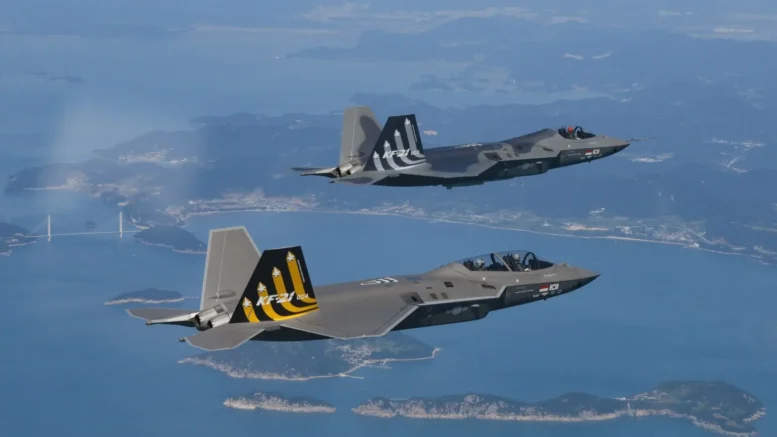
Aviation News – Korea Aerospace Industries (KAI) and Hyundai Rotem have signed a landmark agreement to jointly develop and integrate domestic long-range air-to-air missiles for South Korea’s KF-21 Boramae fighter jet. The strategic collaboration aims to enhance national defense self-reliance while creating integrated aircraft and armament packages for global export markets.
The memorandum of understanding was officially signed on August 12, 2026, at KAI‘s headquarters in Sacheon, located in southeastern South Korea. Under the agreement, the two defense industry leaders will collaborate on the development and systems integration of airborne weapons alongside advanced aircraft platforms such as the KF-21. This initiative marks the third major weapons integration partnership concluded by KAI in 2026, following comparable agreements signed in February at the World Defense Show in Riyadh with Hanwha Aerospace and LIG Nex1.
South Korea’s broader long-range air-to-air missile program is spearheaded by the Agency for Defense Development (ADD) and is scheduled to run from 2026 to 2033. The project gained formal approval from the Defense Project Promotion Committee in late 2025 as part of a comprehensive national air defense upgrade. By developing a domestic beyond-visual-range missile, South Korea seeks to significantly reduce the Republic of Korea Air Force‘s reliance on imported weapons, such as Europe’s MBDA Meteor missile.
From a technical perspective, the partnership combines Hyundai Rotem‘s advanced capabilities in guided weapons and propulsion technologies with KAI‘s established expertise in aircraft platform design and systems integration. Integrating homegrown long-range missiles directly onto the KF-21 ensures seamless flight control software compatibility, optimized radar integration, and complete operational sovereignty. Furthermore, offering fighter jets bundled with native armaments creates competitive package-type exports that appeal to international buyers seeking complete air-defense solutions.
“This agreement will serve as an opportunity to further strengthen our competitiveness in future aerial weapons by combining the core technologies of both companies,” stated an official from Hyundai Rotem regarding the strategic collaboration. “Based on our expertise and business capabilities, we will contribute to strengthening national defense and enhancing self-reliant defense capabilities.”
Looking ahead, the development timeline through 2033 establishes a clear roadmap for South Korea to emerge as a fully self-sufficient provider of advanced combat aircraft and guided missiles. Defense analysts and global procurement agencies are encouraged to closely monitor this program as the KF-21 matures into a fully indigenous, highly competitive multirole platform on the international market.
The joint effort between KAI and Hyundai Rotem represents a pivotal milestone in securing South Korea’s military autonomy and industrial defense capabilities. By replacing foreign-sourced missiles with domestic innovations, the Republic of Korea Air Force achieves greater supply chain security and operational readiness. As flight testing and system integration proceed over the coming years, this collaboration promises to elevate South Korea’s standing among global aerospace powerhouses.