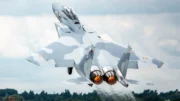
Aviation News – Defense contractor Saab has successfully completed the inaugural flight of the Gripen F, marking a crucial development milestone for the two-seat variant of its advanced Gripen E combat aircraft. Taking off from the company’s facility in Linköping, Sweden, the fighter jet safely flew for 40 minutes to validate its fundamental architecture and operational readiness.
The flight crew consisted of Saab chief test pilot Jakob Högberg alongside Brazilian Air Force Lieutenant Colonel Aviator Abdon de Rezende Vasconcelos. Their joint mission directly confirmed the functionality of the jet’s core systems while establishing early baseline flight parameters. This milestone reflects years of close engineering collaboration between Sweden and Brazil, representing a vital step forward in the multi-national defense partnership.
Technically, the dual-seat Gripen F retains the core performance features of its single-seat counterpart while adding dedicated rear-cockpit systems. This setup enables advanced pilot training scenarios alongside expanded mission management capabilities during high-intensity operations. By sharing task workloads between two aircrew members, the platform increases situational awareness and tactical execution in complex airborne environments.
“This first flight represents an important step forward for both Saab and the Brazilian Air Force. Seeing Gripen F take to the skies is particularly significant for all the Swedish and Brazilian teams whose years of engineering work have helped turn this aircraft into a reality. It is designed to accelerate pilot training while enhancing operational performance in advanced combat missions,” said Lars Tossman, head of Saab business area Aeronautics.
With this mission complete, Saab now transitions the Gripen F into an extensive flight-test campaign focused on expanding the envelope. Future trials will systematically push the fighter’s speed, altitude, G-load limits, and angle of attack to full operational standards. Simultaneously, engineers will rigorously evaluate rear-cockpit avionics and tactical systems in realistic mission settings.
This success cements Saab‘s position in modern tactical aviation while strengthening defense integration with international partners. As flight testing advances, the dual-seater will streamline training pipelines and significantly boost combat versatility for front-line squadrons. The program remains on track to deliver next-generation capability to air forces worldwide.