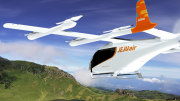
Aviation News – Eve Air Mobility has achieved a critical milestone in urban air mobility by completing the first partial transition flight of its full-scale electric vertical takeoff and landing (eVTOL) engineering prototype. The successful test marks a major step forward in validating the complex transition from vertical hover to wing-borne forward flight.
The milestone flight represents a major achievement for the NYSE- and B3-listed advanced air mobility leader, which operates as a subsidiary of aerospace pioneer Embraer. Building on decades of aerospace engineering expertise, the development program aims to bring safe, quiet, and zero-emission urban air transport to global markets.
Conducted as part of the company’s broader flight-test campaign, the test flight focused on initiating the critical transition phase between vertical lift and conventional forward flight. During the operation, the engineering team successfully activated forward thrust systems to gather crucial performance data while remaining within early flight envelope safety parameters.
Operationally, the test involved activating the aircraft’s rear pusher propeller in flight for the first time, delivering forward propulsion while dedicated vertical lift rotors provided lift support. Operating the pusher at up to 1,200 RPM, the prototype reached a stabilized speed of 27 knots and a maximum ground speed of 30 knots. The total flight lasted 3 minutes and 9 seconds, covering approximately 0.84 nautical miles at a peak height of 90 feet above ground level.
”Successfully activating the pusher propulsion system in flight validates a key aspect of our aircraft design and brings us one step closer to delivering safe, efficient, and scalable air mobility solutions,” stated Johann Bordais, Chief Executive Officer of Eve Air Mobility.
Looking ahead, Eve’s engineering team will continue expanding the flight envelope through structural analysis and planned datalink testing to evaluate radio link performance at speeds up to 50 knots. Industry stakeholders and municipal transport planners should closely monitor these flight test developments as the company progresses toward full wing-borne flight transitions and market entry.
The completion of this initial partial transition test reinforces Eve Air Mobility’s technical momentum in the competitive eVTOL sector. By validating its dual propulsion concept in real-world flight conditions, the company strengthens its path toward airworthiness certification. Continued successful testing will serve as a foundational pillar for future commercial deployment worldwide.