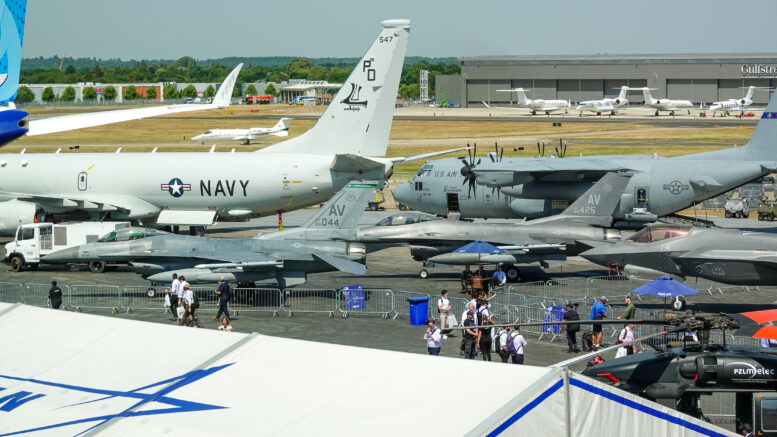
Aviation News – Escalating global security risks will push military defence to the absolute forefront of the upcoming Farnborough Airshow, altering the event’s traditional focus. As aerospace and arms manufacturers scramble to fulfill a massive surge in international weapons demand, the industry must simultaneously stabilize its fragile post-crisis recovery in civil jet and engine production.
The shift in priorities comes at a critical juncture for the aerospace sector as the show prepares to run from July 20 to 24. With the war in Ukraine now entering its fifth year and a fragile ceasefire in tatters across the Gulf region, Western nations are facing severe logistical and manufacturing bottlenecks. These combined geopolitical pressures have rapidly altered the agenda for international industrial coordination.
Historically, the biennial event serves as the primary battleground for the fierce commercial rivalry between Boeing and Airbus as they compete for multi-billion-dollar passenger jetliner orders. However, analysts confirm that this commercial contest has slipped significantly down the pecking order for 2026. The urgent need for state-level deterrence and supply chain reinforcement has fundamentally overtaken corporate market-share battles.
Operationally, arms manufacturers are focusing on ramping up throughput for heavy munitions, tactical missile systems, and next-generation unmanned aerial vehicles (UAVs). Mechanized defense systems require a complex ecosystem of sub-tier suppliers that are currently choked by raw material shortages and skilled labor deficits. Resolving these industrial friction points is vital to sustaining prolonged military readiness without completely derailing commercial airline manufacturing lines.
Industry leaders emphasize that the upcoming exhibition must serve as a functional strategy session rather than a standard trade marketing event. “The current strategic environment demands an unprecedented level of cooperation between governments and the defense industrial base,” noted a leading aerospace manufacturing executive. “We are no longer just filling order books; we are actively securing international supply chains to defend sovereign airspace.”
Looking forward, the decisions made during this summit will likely dictate international procurement cycles for the next decade. Aerospace firms must successfully navigate a dual-track economy where wartime production capacity coexists with civilian travel infrastructure. Observers urge defense ministries and industrial stakeholders to establish binding, long-term production contracts during the five-day event to ensure industrial stability.
The Farnborough Airshow faces an unprecedented landscape defined by urgent military necessity and complex supply chain mechanics. While commercial aviation continues its delicate stabilization process, the shadow of prolonged global conflict has firmly reordered industrial priorities. The event will ultimately test whether the world’s largest aerospace entities can successfully scale up to meet this defining defense challenge.