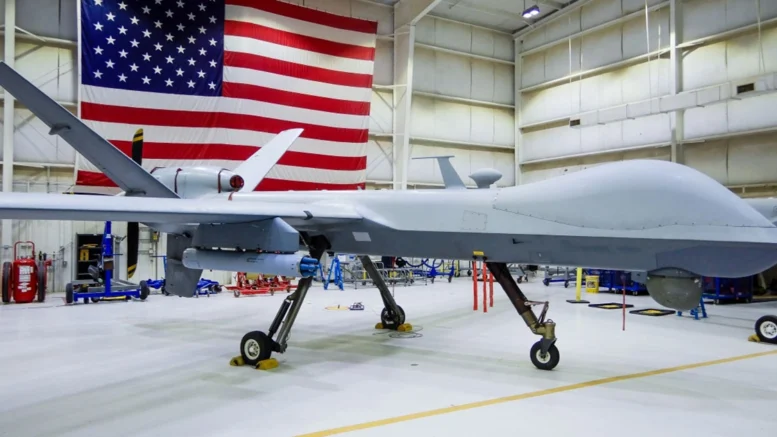
Aviation News – General Atomics and the U.S. Air Force have successfully flight-tested the Advanced Precision Kill Weapon System (APKWS) on an MQ-9A Reaper. This milestone demonstration at the Nevada Test and Training Range proves the aircraft’s ability to utilize low-cost, high-precision rockets against both ground and aerial targets.
The testing, conducted at the Nevada Test and Training Range (NTTR), involved General Atomics Aeronautical Systems, Inc. (GA-ASI) and the U.S. Air Force (USAF). This collaboration aimed to integrate the APKWS into the MQ-9A Reaper platform to meet urgent technological adaptation requirements. By moving rapidly from the planning phase to live-fire flight tests, the teams showcased an accelerated procurement and integration cycle.
Stakeholders from across the Department of Defense and industry partners participated in the event to evaluate the weapon’s effectiveness in diverse combat scenarios. The MQ-9A, a mainstay of remotely piloted aviation, served as the primary launch platform, executing multiple shot profiles. These tests specifically targeted the need for versatile responses to modern battlefield challenges, including the proliferation of unmanned systems.
From a technical perspective, the APKWS transforms standard unguided rockets into laser-guided munitions through the addition of a specialized mid-body guidance section. This allow crews to engage targets with high precision while using a specialized launcher that expands the aircraft’s magazine depth. Operationally, this provides a lower-cost weapon alternative for neutralizing threats that do not require the larger payload of a traditional missile, such as one-way attack drones.
“We recognize the value that a system like APKWS brings to the MQ-9 aircraft as a tool to counter one-way attack drones,” said GA-ASI President David R. Alexander, noting that the effort underscores how government and industry can collaborate to rapidly make new capabilities available to warfighters.
The successful integration of these rockets signals a shift toward more sustainable and flexible armament strategies for remotely piloted aircraft. As global threats evolve, the ability to carry a larger volume of precision munitions will be critical for maintaining air superiority. Military planners are now expected to look toward wider deployment of these systems to safeguard airspace against swarm-style drone tactics.
The MQ-9A Reaper’s new capability enhances its role from a surveillance asset to a formidable multi-mission interceptor. By adopting low-cost precision weapons, the Air Force can now address smaller threats more efficiently without depleting expensive missile inventories. This development marks a significant step forward in rapid military innovation and cost-effective defense.