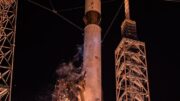
AviationNews – The Federal Aviation Administration (FAA) has officially grounded Blue Origin’s New Glenn rocket and ordered a comprehensive investigation into a recent launch anomaly. The mission failed to deliver an AST SpaceMobile satellite to its intended destination, leaving the spacecraft in an unusable orbit and stalling critical telecommunications progress.
The incident occurred on April 21, 2026, when the heavy-lift New Glenn vehicle suffered a performance issue during its ascent. According to preliminary reports, the rocket’s second stage failed to provide the necessary thrust required to reach the target altitude. This setback is particularly significant for AST SpaceMobile, which relies on these launches to build out its space-based cellular broadband network, and for Blue Origin, as this was a high-profile mission meant to demonstrate the reliability of its newest orbital platform.
Technically, the “underburn” of the second-stage engine meant the satellite could not achieve the velocity needed to maintain a stable, functional orbit. Without the correct orbital parameters, the satellite cannot synchronize with ground stations or provide the intended coverage, effectively rendering the multi-million dollar hardware a total loss. The FAA mandate ensures that all New Glenn flight operations remain suspended until the root cause of the propulsion failure is identified and rectified to prevent future orbital misplacements.
“Safety and precision are the cornerstones of orbital flight, and we are working closely with the FAA to understand the second-stage discrepancy to ensure New Glenn returns to flight stronger,” stated a Blue Origin representative in response to the grounding order.
The future of this partnership now hinges on the speed and transparency of the investigation. For AST SpaceMobile, this represents a significant delay in their global rollout timeline, forcing a re-evaluation of their 2026 launch manifest. Meanwhile, Blue Origin faces intense pressure to prove that this incident was an isolated technical glitch rather than a systemic design flaw in their heavy-lift architecture.
The grounding of the New Glenn rocket underscores the inherent risks of sophisticated space logistics and the stringent oversight of the FAA. As investigators dissect flight data, the industry awaits a resolution that will determine when the next phase of space-based connectivity can resume.