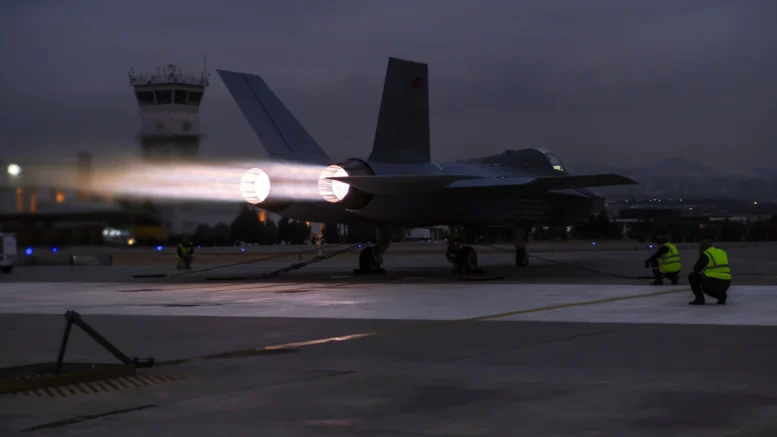
AviationNews Article – The TAI Kaan (formerly known as TF-X) represents Turkey’s most ambitious engineering project to date. Launched by Turkish Aerospace Industries (TAI), the program aims to provide Turkey with strategic autonomy following its removal from the F-35 program in 2020.
As of early 2026, the Kaan has transitioned from a proof-of-concept demonstrator to a series of flight-capable prototypes, with Turkey positioning it as a competitive alternative for nations seeking high-end “ITAR-free” defense solutions.

1. Technical Specifications and “5th Gen” Status
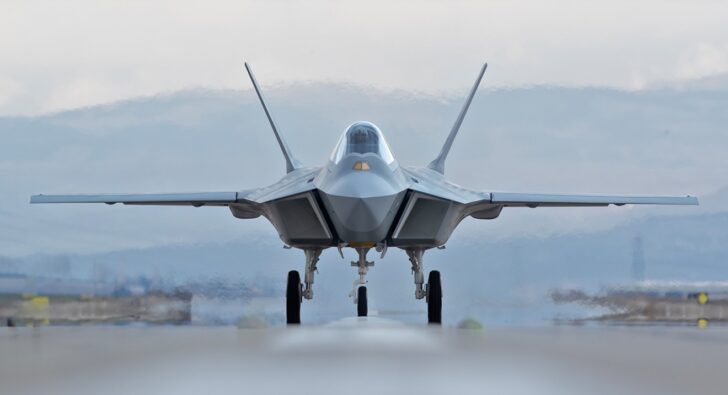
The Kaan is designed to be a twin-engine, all-weather, multi-role air superiority fighter. While it visually resembles an F-22 Raptor, its internal electronic architecture is inspired by the F-35’s sensor fusion.
| Specification | Detail |
| Max Speed | Mach 1.8 |
| Service Ceiling | 55,000 ft |
| G-Limits | +9.0g / -3.5g |
| Engines (Initial) | 2x General Electric F110-GE-129 (131 kN each) |
| Engines (Target 2030s) | 2x TEI TF35000 (Indigenous Turbofan) |
| Key Weapons | SOM Cruise Missiles, Gökdoğan BVR, Bozdoğan WVRAAM |
| Sensors | MURAD-600A AESA Radar, TOYGUN-200 Electro-optical system |
Is it a “True” 5th Generation Fighter?
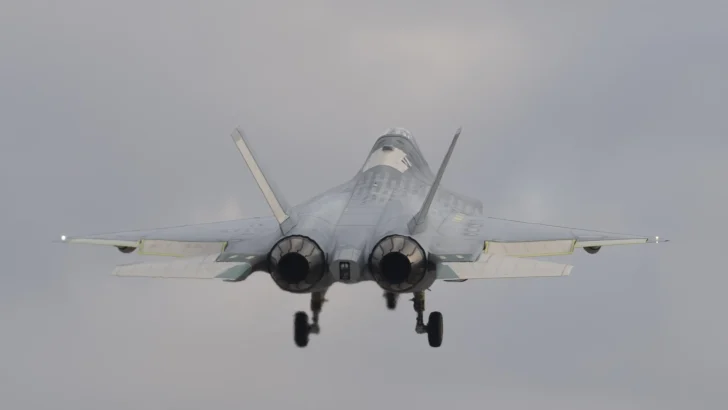
Current prototypes are effectively “4.5+ Gen” because they use the F110 engines, which lack the stealthy serrated nozzles needed to mask infrared and radar signatures. However, once the TF35000 domestic engine and full radar-absorbing coatings are integrated (projected for 2032+), the Kaan is expected to meet full 5th-generation requirements, including supercruise and low-observability.
2. Global Comparison: Kaan vs. The Giants
The Kaan is significantly larger than the F-35, aiming for higher speed and altitude performance, more similar to the F-22 or China’s J-20.
| Feature | TAI Kaan | Lockheed Martin F-35A | Chengdu J-20 |
| Engines | Twin | Single | Twin |
| Internal Hardpoints | 8 | 4 | 6-8 |
| Stealth Rating | Medium (at present) | High | High |
| Situational Awareness | High (AESA + IRST) | Highest (Distributed Aperture) | High |
| Length | 20.3 meters | 15.7 meters | 21.2 meters |
3. Pricing and Financial Feasibility
Turkey’s defense budget for 2026 has surged to approximately $27.3 billion (a 30% increase), specifically to fund the Kaan and its “Steel Dome” air defense network.
- Unit Cost: Initially estimated at $100 million, the price for foreign buyers is currently projected to be competitive with the F-35, likely between $110 million and $130 million per airframe, depending on the configuration.
- Affordability: Critics point to Turkey’s high inflation, but the government has categorized Kaan as a “National Strategic Asset.” Funding is secured through multi-year appropriations that bypass annual budget whims.

4. Sales: Domestic and Foreign
Ankara’s strategy is to use the Kaan as a “diplomatic lever.” By offering a high-tech jet without the strict political strings attached to US-made aircraft, Turkey is attracting significant interest.
- Domestic: The Turkish Air Force (TuAF) plans to acquire over 250 units to replace its aging F-16 fleet, with initial deliveries of the Block-10 variant starting in 2028-2029.
- Foreign Interest: * Indonesia: Signed a historic $10 billion deal for 48 units in June 2025, though they have recently requested a version entirely free of US-made (ITAR) components.
- Saudi Arabia: In February 2026, President Erdogan showcased a Kaan model with Saudi markings. Negotiations are in final stages for a “small squadron” (20 jets) and potential local production.+1
- Azerbaijan & Pakistan: Both nations are strategic partners in the program and are expected to be primary export customers.
Verdict: Is it any good?
The Kaan is “good” in the sense that it is a massive industrial leap for a mid-sized power. While it may not outperform the F-35 in stealth or data-link capabilities in its first iteration, it offers “sovereign combat capability.” This means Turkey can use its own weapons and mission software without needing permission from Washington—a factor that is becoming priceless for many nations in the current geopolitical climate.