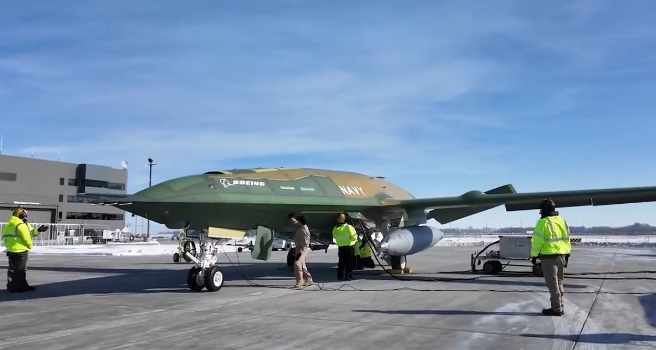
Aviation News – The U.S. Navy’s MQ-25A Stingray unmanned refueling aircraft has completed its first low-speed taxi test at MidAmerica St. Louis Airport, marking a key step toward future carrier-based operations and advancing the Navy’s next-generation air wing capability.
The milestone took place as pilots from Air Test and Evaluation Squadron VX-23 and Unmanned Test and Evaluation Squadron UX-24 monitored the Boeing-built aircraft while it taxied from the company’s production facility to the adjacent taxiway. The test forms part of the MQ-25A development program aimed at delivering the Navy’s first operational carrier-based unmanned tanker, designed to extend the range of manned fighters and reduce strain on existing aircraft.
During the low-speed taxi run, engineers evaluated steering, braking, ground handling and control responses as the aircraft rolled under its own power. These checks verify that the Stingray can safely maneuver on the ground before progressing to faster taxi trials and flight testing. The methodical approach helps bolt together mechanical reliability and software performance ahead of more demanding carrier deck operations.
A Boeing spokesperson said the test demonstrates “steady progress toward delivering a safe, reliable and mission-ready MQ-25A that will expand the reach of the carrier air wing and support sailors in the fleet.”
With ground trials underway, the program is expected to move toward higher-speed taxiing and eventual first flight tests. Once operational, the MQ-25A will provide aerial refueling for F/A-18 and future carrier aircraft, freeing manned jets from tanker duties and allowing them to focus on combat missions.
The successful taxi marks another incremental but critical advance for naval unmanned aviation. As testing continues, the Stingray brings the Navy closer to a new era of longer-range, more flexible carrier operations built around a mix of crewed and uncrewed systems.
