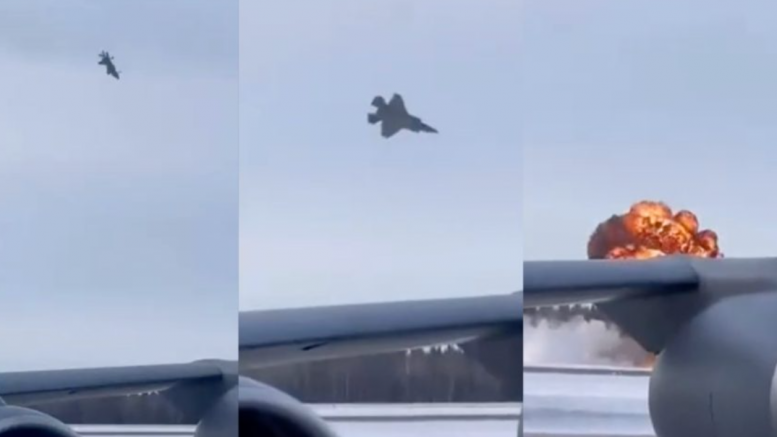
The U.S. Air Force has released the official accident report on the F-35A that crashed at Eielson Air Force Base, Alaska, on Jan. 28, 2025—and it reads like a checklist of how small maintenance lapses can snowball into a big, very expensive problem.
What Happened—The Short Version
Soon after takeoff, the jet’s nose landing gear (NLG) didn’t retract correctly. The pilot entered a hold while working the problem with the Supervisor of Flying and Lockheed Martin engineers on the phone. After roughly 50 minutes airborne, two touch-and-go attempts were made to help re-center the nose wheel. Instead, ice inside the main landing gear struts kept them from fully extending. That fooled the Weight-on-Wheels (WoW) sensors into declaring the jet was on the ground when it was very much airborne—forcing the flight-control system into its ground control laws. The jet became uncontrollable; the pilot ejected and survived with minor injuries. The aircraft, tail 19-5535 from the 355th Fighter Squadron, 354th Fighter Wing, was destroyed on base property.
The Root Cause
Investigators traced the failure to water contamination in the hydraulic fluid for the landing gear. In Arctic temps (about –17°C / 1.4°F that day), the water froze, preventing normal strut movement and proper gear alignment. Post-crash lab tests found roughly one-third of the recovered strut “hydraulic” volume was actually water (e.g., ~1 L water in 2.8 L from the NLG, 1.5 L in 4 L from a main strut).
How The Jet Became Unflyable
- Canting nose gear: The NLG missed its uplock roller and sat canted left (initially ~17–25°), a symptom of the frozen/contaminated system.
- Struts that wouldn’t “stroke”: Ice in the main landing gear (MLG) struts kept them from fully extending. That kept the WoW plungers “depressed,” telling the jet’s computers it was on the ground.
- Control-law trap: With WoW indicating “ground,” the F-35’s fly-by-wire logic shifted to ground-mode laws—great for taxiing, terrible for flight—producing uncommanded oscillations and a rapid loss of control. The pilot ejected at about 620 ft AGL and 222 knots; first responders reached him within a minute.
Maintenance & HAZMAT Findings (The Uncomfortable Part)
The Accident Investigation Board (AIB) cites several systemic contributors:
- Contaminated stock & servicing gear: Both a hydraulic barrel and the hand-servicing cart failed cleanliness checks; photos showed corroded threads and poor sealing that could let moisture in.
- Storage & tracking gaps: Incomplete HAZMAT records and weak tracking of which barrels left/returned to the unit made contamination risks invisible.
- Arctic ops, non-ideal tooling: A hand cart—rather than a nitrogen servicing cart that better flushes and fills struts—meant less fluid volume and more chance that residual water stayed in the struts to freeze later.
Bottom line from the AIB: frozen, water-contaminated hydraulic fluid was the proximate cause; crew decision-making (including the second touch-and-go), HAZMAT oversight, and maintenance procedure shortfalls were substantial contributors. Estimated loss: $196.5 million.
A Close Call—and A Pattern To Watch
Nine days later, another F-35A had a similar nose-gear unsafe indication attributed to frozen hydraulic contamination; that jet landed safely after flying gear-down for ~40 minutes. The Eielson crash was captured in widely shared videos showing the F-35 tumbling wingtip-over-wingtip before impact.
Why This Matters (Beyond One Jet)
- Arctic realities: Cold-weather fleets must treat water intrusion in hydraulics as a mission-killing hazard, not a nuisance. Temperature, exposure time on the ramp, and servicing methods matter.
- Design & ops interface: WoW-driven control-law switching is common across modern fly-by-wire jets; this mishap shows how sensor plausibility checks (e.g., cross-checking air data/attitude versus WoW) and crew procedures can be decisive in rare edge cases. (The AIB even notes Lockheed guidance from 2024 flagging controllability risks tied to WoW.)
- Maintenance rigor: Barrel storage, seal integrity, tool choice, and documented fluid cleanliness (SAE AS4059) aren’t paperwork—they’re flight safety. Expect tightened fluid custody, PODS testing, and cold-weather SOPs across F-35 units.
The Human Factor
The pilot was a current, qualified evaluator with thousands of flight hours (over 2,700 total, ~555 in the F-35A). He earned praise for crew coordination and leadership; his ejection was by-the-book and survivable.
Sources & Further Reading
- PACAF Accident Investigation Board report (PDF) & press releases. The authoritative account with maintenance, weather, and system details. PACAF+2PACAF+2eielson.af.mil
- Coverage and technical distillations: Air & Space Forces Magazine, The War Zone, FlightGlobal, Stars and Stripes. Air & Space Forces MagazineThe War ZoneFlight GlobalStars and Stripes


