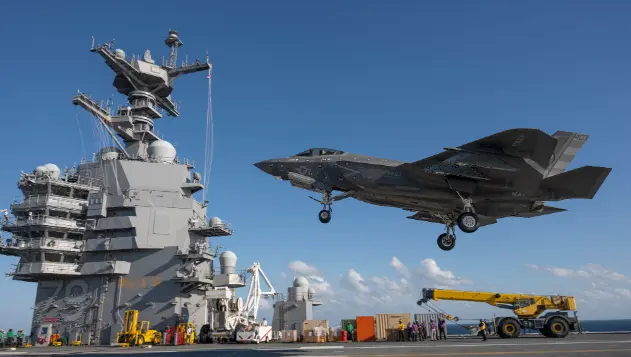
AviationNews – The U.S. Navy has successfully completed the first launch and recovery operations of an F-35C Lightning II stealth fighter aboard a Gerald R. Ford-class aircraft carrier, testing the jet on the future USS John F. Kennedy (CVN 79) in the Western Atlantic. This milestone clears a critical hurdle for integrating fifth-generation naval aviation onto the service’s newest class of nuclear-powered supercarriers.
Two F-35C aircraft assigned to Air Test and Evaluation Squadron 23 (VX-23), known as the “Salty Dogs” and based at Naval Air Station Patuxent River in Maryland, executed the historic Aircraft Compatibility Testing campaign. The first arrested landing took place on October 13, 2026—coinciding with the U.S. Navy’s 251st birthday—followed by the first catapult launch the next day. Over the course of the 11-day evaluation period, the test team completed 34 flights encompassing 122 catapult launches and 122 arrested landings. While the lead ship of the class, USS Gerald R. Ford (CVN 78), entered service without F-35C modifications, the John F. Kennedy was built from the keel up to accommodate the stealth jet.
During the trials, test pilots evaluated the fighter’s compatibility with the carrier’s next-generation flight deck technologies, specifically the Electromagnetic Aircraft Launch System (EMALS) and the Advanced Arresting Gear (AAG). Unlike the traditional steam catapults and hydraulic arresting wires found on older Nimitz-class carriers, EMALS and AAG use software-controlled electromagnetic and water-turbine systems to apply smoother, more precise forces on airframes during takeoff and recovery. Validating these interfaces ensures the F-35C can safely operate at various weights and wind-over-deck conditions without structural stress.
“For the first time, the aircraft has demonstrated launch and recovery operations from a Gerald R. Ford-Class flight deck, advancing the integration of fifth-generation capabilities across the fleet,” Lockheed Martin stated in an announcement highlighting the test campaign.
With preliminary acceptance of the John F. Kennedy already completed, the successful flight deck trials keep the warship on track for formal delivery to the U.S. Navy in spring 2027. The data gathered by VX-23 will establish the operational flight envelopes for future carrier air wings and guide upcoming retrofits for the lead ship of the class.
The successful pairing of the F-35C with the future USS John F. Kennedy marks a transformative step in modernizing American sea power. By validating electromagnetic launch and recovery systems with its premier carrier-based stealth fighter, the U.S. Navy is poised to deploy a significantly more lethal and survivable carrier strike group in the decades ahead.