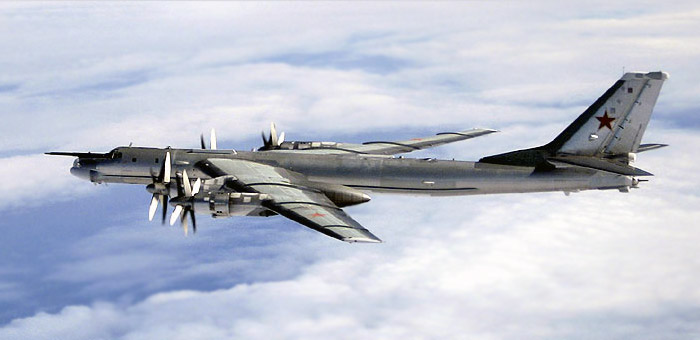
AviationNews – Two Russian Aerospace Forces Tupolev Tu-95MS strategic bombers landed at Da Nang International Airport in central Vietnam on November 17, 2026. The rare Indo-Pacific deployment occurred hours after two suspected Russian military aircraft violated Japanese territorial airspace, prompting emergency fighter scrambles across East Asia.
Satellite imagery confirmed the arrival of the two nuclear-capable bombers—identified by registration numbers RF-94202 and RF-94188—alongside two supporting Ilyushin Il-78M aerial refueling tankers from Ukrainka Air Base in Russia’s Far East. Prior to arriving in Vietnam, a broader formation of Russian aircraft transited the Sea of Japan and the East China Sea, triggering air defense alerts in South Korea and Taiwan. Japan’s Ministry of Defense reported that two suspected Russian aircraft entered Japanese territorial airspace northwest of Okinoshima Island off Fukuoka Prefecture, leading the Japan Air Self-Defense Force to scramble interceptors. The high-profile transit also coincided with preparations for the Asia-Pacific Economic Cooperation (APEC) summit in nearby Shenzhen, China.
Powered by four Kuznetsov NK-12 turboprop engines driving contra-rotating propellers, the Tu-95MS serves as a core airborne pillar of Russia’s long-range strategic aviation fleet. Capable of carrying long-range air-launched cruise missiles across intercontinental distances, the bomber’s operational reach is extended further when paired with Il-78M aerial tankers. Operating from a forward airfield in Southeast Asia allows Russian crews to project strategic presence well beyond their traditional northern Pacific patrol zones.
“Two aircraft believed to be Russian entered Japanese territorial airspace over waters northwest of Okinoshima off Fukuoka Prefecture,” Japan’s Ministry of Defense stated in an official alert detailing the incident and subsequent interceptor response.
Looking ahead, the presence of strategic bombers on Vietnamese soil is likely to draw intense diplomatic scrutiny from Washington, Tokyo, and regional partners concerned about expanding Russian military activity in the South China Sea. Defense analysts will closely monitor whether the deployment remains a brief diplomatic stopover or signals more frequent Russian long-range aviation rotations through Southeast Asia.
The November 17 mission highlights Moscow’s determination to demonstrate global strategic reach despite ongoing military commitments elsewhere. By combining assertive flight paths near allied airspace with a high-visibility landing in Vietnam, the Russian Aerospace Forces have underscored their enduring focus on Indo-Pacific power projection.