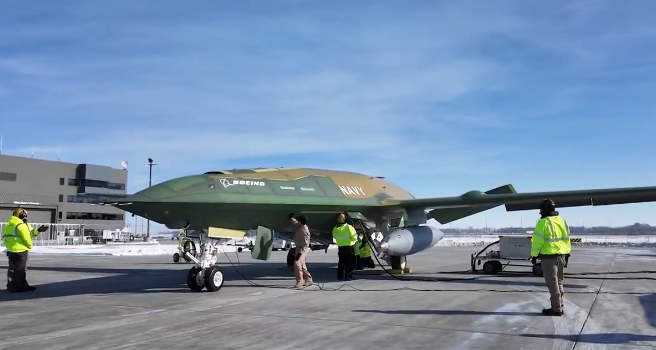
Aviation News – The U.S. Navy successfully controlled an MQ-25A Stingray test aircraft beyond line-of-sight from the aircraft carrier USS Ronald Reagan (CVN 76) using a advanced satellite communications network. The operational milestone marks a crucial step toward fully integrating autonomous unmanned aerial refuelers into carrier strike group operations across global waters.
During a Preliminary Sea Trial in the Pacific Ocean, operators aboard the Nimitz-class carrier used the ship’s Unmanned Air Warfare Center (UAWC) and its MD-5C Ground Control Station to establish a secure link. The test linked the ship directly with an MQ-25A aircraft located thousands of miles away at Boeing’s facility in Mascoutah, Illinois. The long-range connection was routed through a Proliferated Low Earth Orbit (pLEO) satellite network, demonstrating robust control capabilities across massive oceanic distances.
This trial represents the latest phase in a series of build-up exercises executed by the Unmanned Carrier Aviation Program Office (PMA-268). The program relies on a collaborative MQ-25 Integrated Test Team that brings together experts from the U.S. Navy, Boeing, and Lockheed Martin. Prior to this oceanic flight trial, the joint team conducted extensive pier-side and sea-based testing to validate digital networks, operational software, and command interfaces.
By shifting command and control signals to low-altitude satellite constellations, carrier units can maintain continuous control of unmanned aircraft without relying on direct line-of-sight radio antennas. The operational deployment of the MQ-25A Stingray will allow carrier air wings to extend the flight range and endurance of manned tactical fighters, including F/A-18 Super Hornets, by providing aerial refueling capabilities far from host carriers. This transition relieves strike aircraft from secondary tanker roles, freeing frontline fighters for primary combat missions.
“The MQ-25A Stingray’s carrier-based refueling capabilities enable F/A-18 Super Hornets to fly farther and longer,” said the Acting Secretary of the Navy, the Honorable Hung Cao. “The integration of this unmanned aerial refueler demonstrates the transformational change our manned and unmanned asset integration provides the Fleet.”
Successful integration of high-bandwidth satellite networks into carrier command centers establishes a baseline for future autonomous operations across military fleets. As the program progresses, testing will shift toward full carrier landing trials and routine operational integration with manned squadrons. Expanding this network architecture ensures carrier strike groups retain operational reach and strategic agility in contested maritime environments.