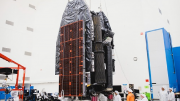
Boeing has officially delivered the ViaSat-3 Flight 3 (VS-3 F3) spacecraft to Viasat, marking a pivotal advancement in global telecommunications. This state-of-the-art satellite will serve the Asia-Pacific region, providing high-capacity bandwidth and resilient connectivity for both commercial aviation and defense sectors.
The spacecraft represents the third installment in Viasat’s ultra-high-capacity constellation, designed to provide global coverage. Integrated at Boeing’s specialized facility in El Segundo, California, the satellite utilizes the high-power 702MP+ platform. This delivery follows years of technical collaboration between the two aerospace giants and signifies the completion of the manufacturing phase for the Asia-Pacific segment of the network.
The project reached this milestone following rigorous environmental testing and verification to ensure the hardware can withstand the harsh conditions of geostationary orbit. While the first two satellites in the series focused on the Americas and the EMEA regions, this third unit specifically targets high-density markets across the East. The move is timed to meet the skyrocketing demand for “anywhere, anytime” internet access in one of the world’s fastest-growing digital economies.
Technologically, the 702MP+ platform is an engineering marvel that supports power-intensive payloads and features an all-electric propulsion system. This allows for more precise orbital positioning and a lighter overall weight, which translates to greater efficiency and a longer operational lifespan. For the ViaSat-3 mission, Boeing scaled the platform to accommodate massive solar arrays and advanced electronics capable of delivering over 1-Terabit per second of network capacity.
The satellite is now at Cape Canaveral, Florida, awaiting its upcoming launch aboard a SpaceX Falcon Heavy rocket. Once operational, it will allow Viasat to dynamically shift capacity to where it is needed most—whether for a commercial airliner over the Pacific or a naval vessel in a remote corridor. This flexibility ensures that bandwidth is never wasted and performance remains consistent even during peak usage.