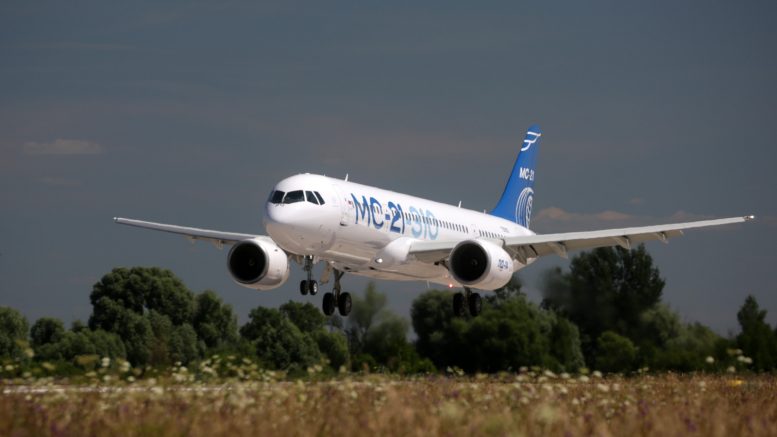
Aviation News – Russia’s federal air transport regulator is accelerating certification of the MC-21-310 by adding two more aircraft to its flight-test programme, aiming to meet an October deadline and advance domestic aviation independence.
The regulator, Rosaviatsia, confirmed that the additional MC-21-310 jets will support an intensive certification effort following delays caused by the aircraft’s redesign with locally sourced systems. The programme reflects Russia’s broader import-substitution strategy, developed in response to reduced access to foreign aerospace components. Officials noted that around 200 flight tests remain, alongside approval of 88 components and review of more than 250 certification documents.
The MC-21-310, developed by Yakovlev, has been extensively modified to replace Western-supplied parts with domestic alternatives. This shift has extended timelines but is seen as critical for long-term self-reliance. In parallel, certification work is progressing on the SJ-100 regional jet and its Aviadvigatel PD-8 engine, as well as the Ilyushin Il-114-300 turboprop, all of which are targeted for near-term entry into service.
“Russia is the only country in the world that manufactures aircraft entirely domestically,” said Dmitry Yadrov, head of Rosaviatsia. “This year, we face four key certification challenges,” he added, noting that most testing for the PD-8 engine has already been completed, including 150 hours of service-life validation.
The addition of test aircraft is expected to shorten certification timelines by enabling parallel flight trials and faster validation of systems performance. This approach could help resolve bottlenecks in compliance testing while improving overall programme efficiency for the MC-21-310 and related aircraft.
Looking ahead, regulators aim to complete certification of the MC-21 by October, while the SJ-100 is expected to secure approval as early as July. If successful, these milestones would mark a significant step toward restoring Russia’s civil aviation production pipeline with domestically built aircraft.
The acceleration of certification signals a strategic push to stabilise the country’s aerospace sector under constrained conditions. While challenges remain, progress on the MC-21-310 and related programmes could reshape Russia’s commercial aviation landscape in the coming years.
