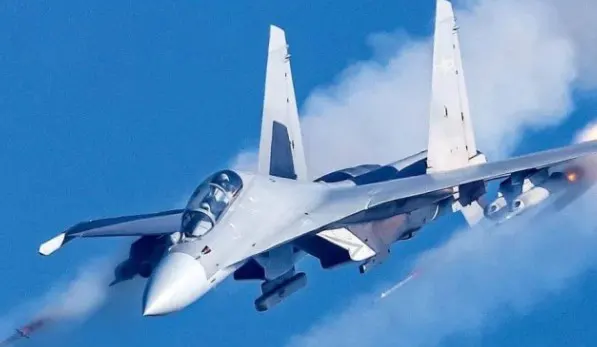
AviationNews – The People’s Liberation Army (PLA) has reported a high-stakes aerial encounter where a Chinese J-16 fighter jet successfully locked its radar onto an unidentified stealth aircraft at a distance of just 800 meters. The incident, disclosed by the official PLA Daily, underscores the intensifying “cat-and-mouse” games currently unfolding in the sensitive airspace managed by the Eastern Theater Command.
According to the military report released in February 2026, the confrontation occurred during a gecoordinated interception mission launched to counter what Beijing described as “aerial provocations.” While the exact date and location remain classified, the Eastern Theater Command’s jurisdiction covers flashpoints such as the Taiwan Strait and the East China Sea. Defense analysts believe the Chinese aircraft involved was the Shenyang J-16, a versatile, multi-role fighter that has become the backbone of the PLA’s regional patrols. This marks the second high-profile anti-stealth claim by Chinese state media in less than five months, following a similar encounter reported in late 2024.
Operational highlights of the encounter reveal a tactical “pincer” maneuver executed by the J-16 pilot and their wingman. By closing the gap to 800 meters—well within visual range—the Chinese jets effectively negated the “stealth” advantage of the target, which relies on long-distance radar deflection. A radar lock at this proximity indicates that the J-16’s Active Electronically Scanned Array (AESA) radar was transition from search mode to a continuous tracking “fire-control” state. This procedure signifies that the weapon systems are fully engaged and ready for immediate deployment, often used as a final warning to force an intruder to disengage.
“Our pilots demonstrated exceptional tactical coordination, maintaining a firm radar lock even as the target attempted aggressive evasive maneuvers,” stated an official report from the PLA Eastern Theater Command. “This action proved our capability to detect and deter any low-observable threat entering our sovereign airspace.”
The future outlook for regional security remains precarious as these close-quarters interactions become more frequent. As the United States and its allies continue to deploy fifth-generation stealth fighters like the F-22 Raptor and F-35 to the Indo-Pacific, the PLA is likely to further increase its aggressive patrol cycles. These developments suggest that the technical edge once held by stealth technology is being challenged by advanced sensor fusion and bold pilot tactics.
The reported lock-on by the J-16 represents a significant psychological and technical milestone for the Chinese Air Force. By successfully tracking a stealth target at point-blank range, the PLA aims to demonstrate that its air defenses are robust against Western “invisible” jets. As tensions in the Asia-Pacific rise, such encounters serve as a stark reminder of the potential for accidental escalation in contested skies.