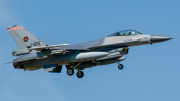
Date of incident: June 10, 2025 (Alaska time) | Approx. 4 p.m. local
Location: Eielson Air Force Base, near Fairbanks, Alaska
Event: Republic of Korea Air Force F‑16D Fighting Falcon crash during takeoff
What happened
- A two-seater KF‑16D, part of the South Korean contingent training at Red Flag‑Alaska, began its takeoff roll but skidded off the paved runway into the grass infield just prior to ascending
- Both South Korean pilots, both holding the rank of Captain, initiated ejection shortly after takeoff
Pilot condition & rescue
- Emergency crews from the USAF’s 354th Fighter Wing and local responders arrived promptly. Observers noted around 8–10 emergency vehicles on scene
- The pilots, who suffered minor burns and lacerations, were transported to Bassett Army Community Hospital at Fort Wainwright and released after evaluation f-
Aircraft aftermath
- The jet caught fire after sliding into the grassy area adjacent to the runway. Firefighting units extinguished the blaze; the fuselage was partially destroyed by fire and remains damaged on site
Investigation & response
- The South Korean Air Force has dispatched a 20‑member on-site investigation and repair team to Eielson
- A preliminary probe indicates pilot error as the likely cause: reportedly, three KF‑16s inadvertently entered a taxiway instead of the runway. The second jet, having insufficient runway left after aborting the takeoff, required ejection
- All participating KF‑16s were temporarily grounded, with operations expected to resume by June 13 or 14, and training flights are set to continue within the Red Flag exercise framework.
- A joint Korean–U.S. effort will finalize the accident investigation and implement corrective measures focused on airfield procedures.
Context & broader details
- Red Flag‑Alaska is a premier multinational aerial combat training exercise involving approximately 70+ aircraft and 1,500 personnel from the U.S., South Korea, and Japan; South Korea’s deployment includes about 11 aircraft and 100 personnel, including six KF‑16 fighters and a KC‑330 tanker.
- The KF‑16D is a domestically upgraded variant of the U.S.-built F‑16 Fighting Falcon.
- This mishap brings the total KF-16 crashes in South Korea to fifteen since 1999, with two others in 2025 alone.
Facts & Figures at a Glance
| Item | Details |
|---|---|
| Aircraft | KF‑16D (two-seater variant of F‑16 Fighting Falcon) |
| Crew | 2 — both Captains, South Korean Air Force |
| Time of ejection | ~4 p.m. (AKDT) on June 10, 2025 |
| Injuries | Minor burns and lacerations; both released from hospital |
| Damage | Aircraft partially destroyed by fire in grass |
| Initial cause | Pilot confusion: taxiway vs runway entry |
| Grounding & response | KF‑16 fleet grounded; 20-person Korean team sent; ops resume ~June 13 |
| Exercise details | Red Flag‑Alaska: 70+ aircraft, ~1,500 personnel, runs mid‑June 2025 |
Significance & Safety Takeaways
- Ejection systems on the F‑16D demonstrate high effectiveness—both aircrew walked away with non-life-threatening injuries.
- However, the pilot error incident spotlights the critical importance of taxiing protocols and air traffic control coordination, especially in complex, multi-national training environments.
- The quick dispatch of the investigation team and decision to resume operations quickly suggest strong Korean–U.S. military cooperation and a focus on maintaining readiness.