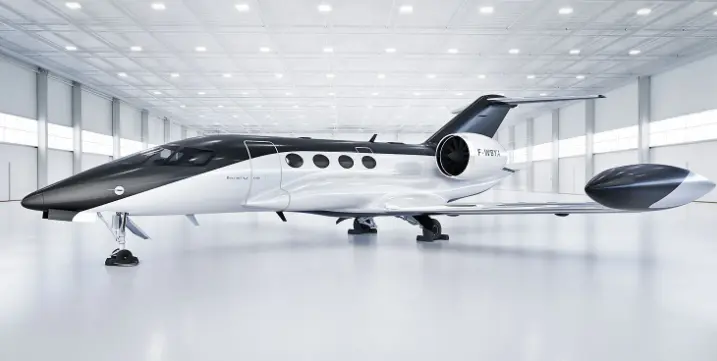
AviationNews – French aerospace manufacturer Dassault Aviation has formally terminated its internal research into hydrogen propulsion for future aircraft. Chairman and CEO Éric Trappier confirmed the strategic shift on November 15, 2026, citing major engineering and range limitations for long-distance business jets.
Speaking during a joint radio and television appearance on the French political program Le Grand Jury, hosted by RTL and Public Sénat, Trappier clarified that the company no longer views hydrogen as a practical power source for its product lineup. The announcement underscores growing skepticism within the business aviation sector regarding the near- and medium-term feasibility of zero-emission hydrogen flight and the airport refueling infrastructure required to support it. Rather than pursuing radical airframe redesigns for alternative propulsion, Dassault is redirecting its engineering resources toward bio-based and synthetic Sustainable Aviation Fuels (SAF) alongside incremental aerodynamic and engine efficiency gains.
To illustrate the technical hurdles, Trappier pointed directly to the flagship Falcon 10X, Dassault’s largest ultra-long-range business jet, which completed its maiden flight in June 2026 ahead of a planned 2029 service entry. Designed for a range of 7,500 nautical miles (13,890 kilometers), the aircraft depends on high-density fuel storage to preserve cabin space. While liquid hydrogen delivers more energy per unit of mass than conventional kerosene, it requires roughly four times the storage volume and must be maintained at cryogenic temperatures near minus 253 degrees Celsius. Integrating heavy, heavily insulated cylindrical tanks into a sleek business jet fuselage would severely compromise both cabin dimensions and intercontinental range.
“At Dassault, we have stopped researching,” Trappier stated during the Le Grand Jury broadcast, emphasizing that hydrogen propulsion cannot realistically meet the operational demands of long-range executive aviation.
Moving forward, Dassault Aviation will concentrate on drop-in SAF solutions—including e-SAF synthesized from captured carbon and green hydrogen—which work seamlessly with existing engines and airport fueling networks. All current Falcon models are already certified to fly on blends of up to 50 percent SAF, while the Falcon 10X’s Rolls-Royce Pearl 10X engines are engineered for 100 percent SAF compatibility. Industry observers and operators watching business aviation’s decarbonization roadmap can expect manufacturers to increasingly prioritize synthetic fuel supply chains over experimental hydrogen airframes.
By halting its hydrogen propulsion program, Dassault Aviation draws a clear boundary between short-haul regional concepts and the physics of intercontinental business travel. The manufacturer’s commitment to Sustainable Aviation Fuels and conventional propulsion refinement signals a pragmatic path toward lowering carbon emissions without sacrificing range or cabin comfort.