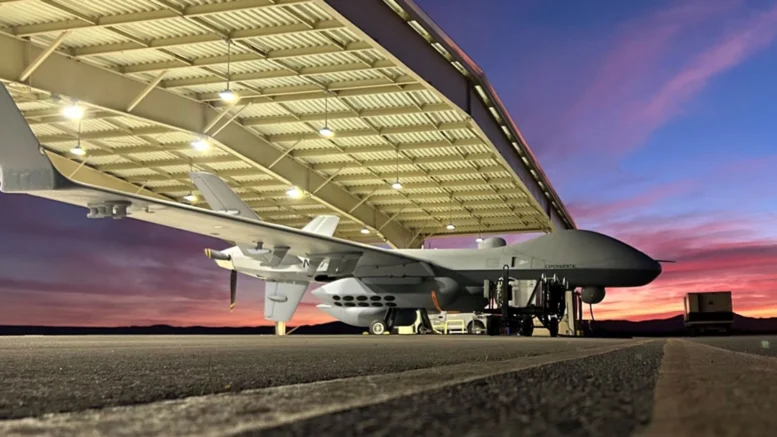
Aviation News – The U.S. Navy evaluated the MQ-9B SeaGuardian® uncrewed aircraft system from General Atomics Aeronautical Systems, Inc. (GA-ASI) at Naval Air Station Whidbey Island in Washington. Operated under a company-owned, company-operated contract, the maritime platform supports an ongoing capability assessment to enhance intelligence and anti-submarine operations for the 7th Fleet.
The operational evaluation occurred at the Maritime Patrol and Reconnaissance Force (MPRF) Commander’s Operational Group (COG) facility in Oak Harbor, Washington. Organized at the request of the Commander, Patrol and Reconnaissance Group, the event brought together senior military leaders, defense tacticians, and industry specialists to analyze next-generation naval aviation tools. The specialized assessment focused on refining modern Anti-Submarine Warfare (ASW) operational tactics, techniques, and procedures currently deployed throughout operational fleets.
GA-ASI provided the maritime-optimized MQ-9B SeaGuardian—a Group 5 remotely piloted aircraft system—to deliver an up-close operational assessment for defense officials and international military partners. The platform previously participated in the 2025 Whidbey Island Open House to highlight unmanned integration alongside traditional crewed aircraft. Operating under an active Company-Owned, Company-Operated (COCO) framework, the aircraft delivers persistent maritime domain awareness while allowing naval leadership to continuously test real-world deployment scenarios.
The MQ-9B SeaGuardian operates as a high-altitude, long-endurance uncrewed system configured with advanced surface search radar, signals intelligence packages, and acoustic sensor suites for undersea tracking. Its long-range flight endurance enables continuous wide-area surveillance over vast ocean corridors, significantly reducing operational wear on crewed maritime patrol aircraft. By streaming real-time operational data directly to command hubs, the platform accelerates threat identification and enhances strategic decision-making across contested maritime environments.
“I am pleased to support the Navy’s continuing engagement efforts with our MQ-9B and appreciate leadership’s ongoing support of SeaGuardian operations as we demonstrate the capability of this multi-faceted system to fill critical capability gaps,” stated GA-ASI President David R. Alexander regarding the ongoing evaluations.
The successful assessment marks a critical step forward in integrating autonomous aircraft platforms into routine naval fleet operations. As maritime security challenges expand across global waters, long-endurance uncrewed systems will play a pivotal role in strengthening multi-domain reconnaissance and defense capabilities. Defense analysts expect these evaluations to establish new benchmarks for joint operational tactics, paving the way for expanded uncrewed deployments across international naval theaters.