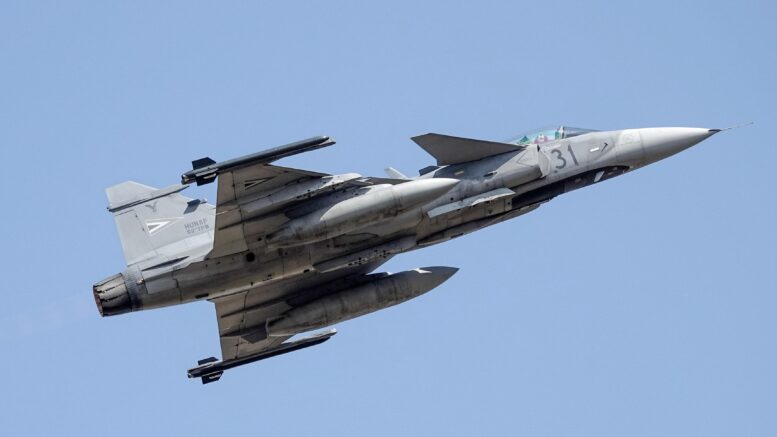
Aviation News – A Hungarian Air Force Gripen fighter jet carrying live ordnance crashed during an emergency landing at Szolnok Air Base following a catastrophic onboard computer malfunction. The pilot successfully ejected prior to impact, escaping without major injuries before being transported to a hospital as a precautionary measure.
The armed JAS 39 Gripen was operating out of its primary station at Kecskemét Air Base (LHKE) as part of a two-ship formation conducting routine standby training procedures. During the flight, critical flight electronics and internal instruments suffered a complete operational failure, prompting the pilot to issue an emergency broadcast. Accompanied by his wingman, the pilot diverted to Szolnok Air Base (LHSN) to perform a visual, unassisted forced landing under extreme conditions.
Initial reports from the official Ministry of Defense press conference indicate that the jet touched down successfully on the runway surface. However, a post-landing deviation forced the pilot to execute an immediate low-altitude ejection as the airframe veered out of control. The aircraft subsequently skidded off the paved runway boundary, causing an onboard fire to break out upon landing gear collapse. Emergency fire crews at Szolnok responded immediately to contain the wreckage, which remained armed with active munitions.
Total electronic failures in modern digital fly-by-wire (FBW) combat aircraft represent severe operational hazards. Because advanced platforms like the Saab JAS 39 Gripen rely heavily on flight control computers to maintain aerodynamic stability, losing onboard instruments disables standard flight guidance, telemetry display, and hydraulic management systems. In high-workload scenarios involving live air-to-air or air-to-ground ordnance, executing a manual touchdown with zero flight data feedback significantly elevates the risk of gear structural failure and ground control loss.
”Our defense systems responded immediately to the declared airborne emergency, and the pilot’s quick decision-making under total instrumentation loss prevented loss of life,” stated an official military representative during the press briefing. “An expert military commission is already on-site to inspect the flight data recorders, evaluate the wreckage, and establish why the primary power and flight avionics failed simultaneously.”
The accident marks a significant loss for the Hungarian Air Force, which relies on its Gripen fleet for national airspace defense and NATO quick reaction alert (QRA) missions. While air safety investigators work to secure the crash zone at Szolnok, preliminary inquiries focus on power distribution units and computer hardware architecture to prevent fleet-wide grounding risks.


