Aviation News – A broken engine fan blade caused a passenger cabin window to shatter on a Ryanair flight, resulting in a traveler being partially pulled out of the aircraft before emergency procedures brought the jet safely to the ground. A preliminary report released by the National Transportation Safety Board (NTSB) confirms initial suspicions regarding the root cause of the severe mid-air incident.
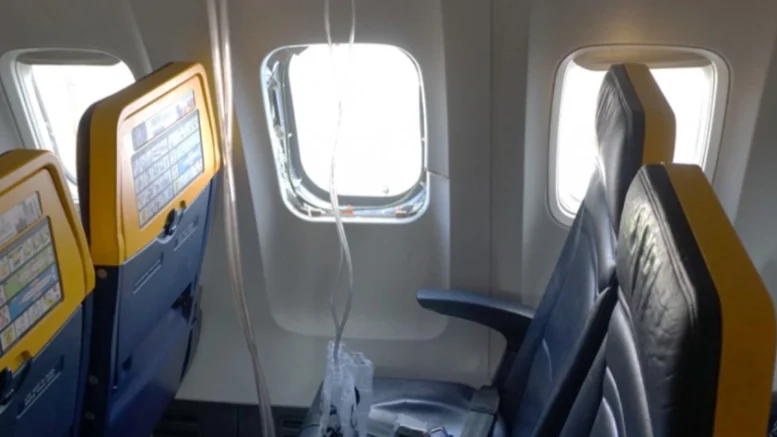
The dramatic event occurred on July 10, 2026, aboard a Boeing 737-800 operating a scheduled flight from Thessaloniki, Greece, to Memmingen, Germany. Shortly after departure, the aircraft’s right-hand engine suffered a catastrophic mechanical malfunction. High-velocity fragments broke free from the engine fan blades, striking the fuselage directly and piercing through an adjacent cabin window.
The sudden puncture triggered an immediate cabin depressurization, causing a Serbian passenger seated beside the window to be drawn partially outside the aircraft frame. His wife and nearby travelers reacted instantly, holding onto him firmly and pulling him back into the aircraft interior. Although the passenger survived the ordeal, he sustained severe injuries during the rapid decompression event. Because the aircraft was manufactured in the United States, the NTSB took the lead on the technical investigation alongside the Federal Aviation Administration (FAA), aircraft builder Boeing, and engine creator GE Aerospace.
In uncontained engine events, structural failure within the engine housing allows high-energy debris to breach the outer protective cowl and strike the main aircraft body. Detailed photographic evidence published by investigators demonstrates clear damage to the surrounding fuselage and a prominent structural hole where fragments pierced the engine casing. Ground maintenance teams and specialized investigators continue to analyze metal fatigue, blade integrity, and operational stress logs to determine what initiated the engine component failure.
“The safety of air travel relies on rigorous technical investigations that isolate failure points and prevent future occurrences,” stated aviation safety analysts reviewing the preliminary findings. “Collaborative efforts between international air safety agencies, aircraft manufacturers, and engine developers ensure that findings translate directly into enhanced structural and mechanical safeguards.”
This ongoing investigation will provide essential technical insights for global aviation authorities assessing engine maintenance standards and airframe protection protocols. Federal safety officials plan to examine component stress histories to establish whether manufacturing defects, material fatigue, or environmental factors triggered the initial break. Moving forward, the results could lead to updated airworthiness directives and revised inspection schedules for similar engine models worldwide.
The interim NTSB report establishes a clear timeline of the physical failure that led to cabin depressurization and passenger injury. Multi-agency teams will maintain their detailed technical analysis to discover why the fan blade failed during flight. Final safety recommendations and conclusive findings will follow once engineers complete full metallurgical testing on the recovered engine components.