AviationNews – Gulfstream Aerospace and Rolls-Royce have successfully completed an industry-first high-altitude flight test demonstrating that operating business jets on 100% Sustainable Aviation Fuel (SAF) significantly reduces contrail-forming particulate emissions. This breakthrough provides crucial evidence that alternative fuels can actively mitigate the non-CO2 climate impacts of modern aviation.
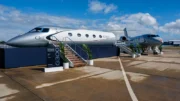
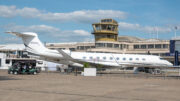
During the collaborative test campaign, a Gulfstream G800 powered by Rolls-Royce Pearl 700 engines performed the groundbreaking flights entirely on neat SAF. To analyze the environmental impact, the team deployed a specially modified Gulfstream G700 as a trailing airborne laboratory to measure emissions at altitudes up to 50,000 feet, which exceeds typical commercial airliner cruising levels. The research team, which included the Federal Aviation Administration (FAA), NASA, and the German Aerospace Center (DLR), specifically tested unblended Hydro-processed Esters and Fatty Acids (HEFA) SAF to compare its output directly against conventional, low-sulfur jet fuel.
By flying the two aircraft in precise, close formation, researchers captured real-world data on both near-field engine emissions and atmospheric contrail evolution several miles behind the lead jet. The preliminary findings confirm that burning 100% SAF drastically decreases the specific soot and particulate emissions responsible for forming persistent contrails. Because persistent contrails trap heat in the atmosphere and serve as a major driver of aviation-induced global warming, minimizing their formation is essential for mitigating overall climate impact. Furthermore, the rigorous testing verified that modern, in-production business jet engines can operate safely and efficiently without blending the alternative fuel with conventional fossil fuels.
“This campaign reflects our strategy to lead with advanced technology, real-world testing, and meaningful collaboration to better understand and reduce aviation’s environmental impact,” stated Mark Burns, president of Gulfstream.
Although current aviation industry standards only permit the commercial use of SAF in blends of up to 50%, these definitive high-altitude test results will help pave the way for updated certifications. Researchers will share the comprehensive flight data with global atmospheric science communities to refine climate models and build a strong case for the worldwide approval of unblended SAF. Aerospace manufacturers, fuel suppliers, and regulatory bodies must now work together to scale SAF production and adapt existing frameworks to fully unlock these vital environmental benefits.
The pioneering flight tests by Gulfstream and Rolls-Royce deliver clear proof that 100% SAF effectively curbs both direct carbon emissions and complex contrail formations. As the aerospace sector pushes toward ambitious net-zero targets, adopting unblended sustainable fuels will play a defining role in reducing the broader climate footprint of global flight operations.