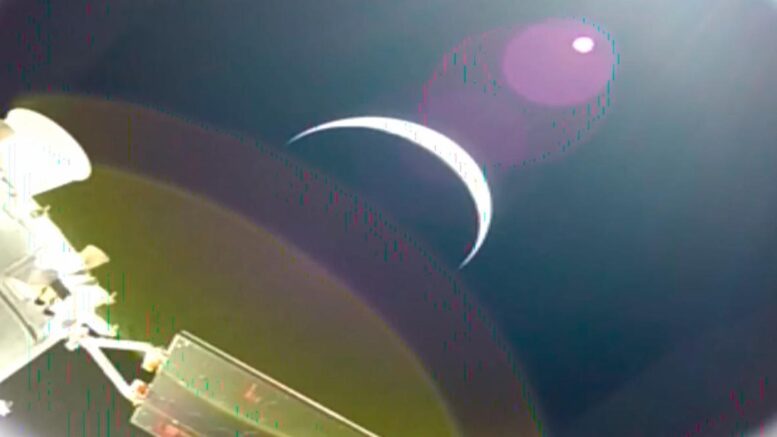
For the first time in over five decades, a crewed spacecraft has successfully departed Earth’s orbit to journey toward the Moon. Following a critical six-minute engine burn on Thursday, April 2, 2026, NASA’s Artemis II mission is now on a precise trajectory for a lunar flyby, marking a monumental leap in the modern era of space exploration.
The mission, which lifted off from Launch Pad 39B at the Kennedy Space Center on April 1, carries a diverse crew of four: NASA astronauts Reid Wiseman, Victor Glover, and Christina Koch, alongside Canadian Space Agency astronaut Jeremy Hansen. This 10-day flight test serves as the first crewed mission of the Artemis program, utilizing the massive Space Launch System (SLS) rocket and the Orion spacecraft to pave the way for a long-term human presence on the lunar surface.
The pivotal moment occurred during the translunar injection burn, where the spacecraft’s service module engine fired to accelerate the vehicle enough to escape Earth’s gravitational pull. Before this maneuver, the crew spent approximately 24 hours in high Earth orbit conducting a manual piloting demonstration and verifying that the spacecraft’s life support systems—operating with a crew for the first time—were performing nominally.
Technically, the success of this mission relies on the seamless integration of the Orion capsule and its European-built service module. The translunar injection is the high-stakes “push” that transitions the mission from an orbital test to a deep-space voyage. By reaching speeds necessary to break free of Earth, the crew is now testing the limits of deep-space communication and radiation shielding, essential data for the upcoming Artemis III mission which aims to land humans on the Moon.
“Today, for the first time since Apollo 17 in 1972, humans have departed Earth orbit. Reid, Victor, Christina, and Jeremy now are on a precise trajectory toward the Moon. Orion is operating with crew for the first time in space, and we are gathering critical data, and learning from each step,” said Dr. Lori Glaze, acting associate administrator for the Exploration Systems Development Mission Directorate at NASA.
The successful outbound trajectory sets the stage for a lunar flyby scheduled for April 6, where the astronauts will venture further than any human has traveled before. This mission is a foundational “rehearsal” for future sustainable exploration, including the construction of a lunar base and eventual crewed missions to Mars.
As Orion continues its four-day transit to our nearest neighbor, the world watches a new chapter of discovery unfold. The data harvested during these ten intensive days will define the safety protocols for the next generation of explorers. With Artemis II, the dream of returning to the lunar surface is no longer a distant goal, but an active reality.