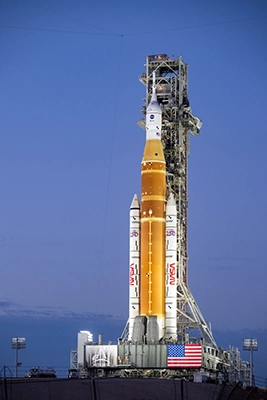
Aviation News – Northrop Grumman’s five-segment solid rocket boosters will launch NASA’s first crewed Space Launch System mission, Artemis II, from Kennedy Space Center as early as February 6, 2026. The flight marks a major bolt in NASA’s plan to return humans to deep-space exploration.
NASA confirmed that two Northrop Grumman-built boosters will lift the SLS rocket from Pad 39B at Kennedy Space Center in Florida. The mission, Artemis II, will be the first crewed flight of the SLS and Orion spacecraft, building on the successful uncrewed Artemis I mission that validated the system’s core design and performance.
Each booster stands 177 feet tall and produces 3.6 million pounds of thrust, making them the most powerful solid rocket boosters ever flown on a human spaceflight mission. Evolved from the Space Shuttle-era four-segment design, the five-segment boosters provide more than 75 percent of the rocket’s total thrust, operating as a matched pair during ascent to push the crewed spacecraft beyond Earth orbit.
“These boosters are a critical foundation for Artemis II and future missions, delivering the power and reliability needed to safely carry astronauts into deep space,” a Northrop Grumman spokesperson said, noting the company also supplies key motors for the Orion Launch Abort System.
Beyond propulsion, Northrop Grumman manufactures the attitude control motor and abort motor for the Launch Abort System, which is designed to rapidly pull the Orion capsule and crew away from the rocket in the event of an emergency during launch or ascent. This safety system will be active for the entire Artemis II launch phase.


