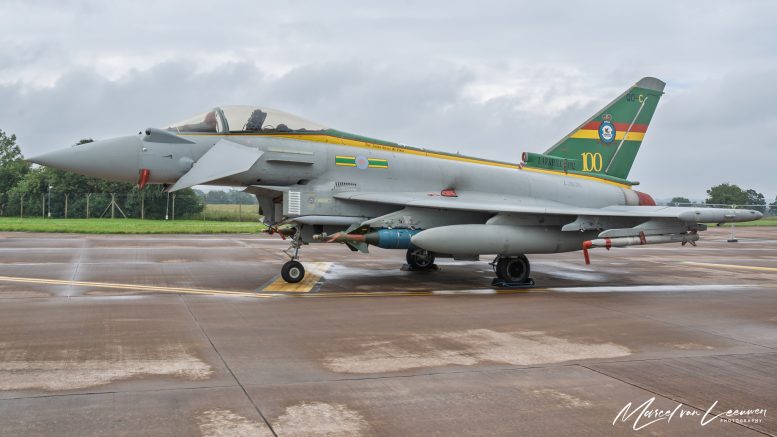
The Royal Air Force is closing a major chapter in its history. Most of its earliest Tranche 1 Eurofighter Typhoons have now been retired, with 26 already scrapped and just four still flying. Those remaining jets serve as Quick Reaction Alert aircraft in the Falklands, where they’ll remain on duty until 2027.
In total, the RAF originally had 30 Tranche 1 Typhoons. Some of the retired airframes are being stripped for spare parts, converted for training, or awaiting disposal. Although experts have noted it would be technically possible to modernize them, no upgrade program has been approved.
The Future Belongs to Tranche 2 and 3
The RAF’s more advanced Tranche 2 and 3 Typhoons—107 jets in total—will remain the backbone of the fleet until at least 2040. To keep them competitive, a major modernization effort is underway.
At the center of this is the ECRS Mk2 radar, an advanced active electronically scanned array system that will boost the Typhoon’s ability to detect, track, and jam enemy threats. First flight tests have already been completed, and the system is expected to begin rolling out to operational squadrons before the end of the decade. The radar upgrade is not only about keeping the aircraft lethal—it also sustains thousands of British engineering jobs.
Debating the Next Step
Some in defense circles argue the UK should order new Typhoons to maintain domestic aerospace skills. Others believe the focus should shift to the F-35 Lightning II, the stealth fighter that already flies with the RAF and Royal Navy. Both aircraft complement each other well: the stealthy F-35 boosts battlespace awareness, while the Typhoon provides raw power and payload.
Enter Tempest: Britain’s Sixth-Gen Jet
The real excitement, though, is around the Global Combat Air Programme (GCAP)—a partnership between the UK, Italy, and Japan to build a sixth-generation fighter jet. Nicknamed Tempest, this new aircraft is set to take flight around 2027, with frontline service planned for 2035.
Designed with cutting-edge technologies like 3D-printed parts, digital engineering, and AI-assisted systems, Tempest is meant to ensure the UK retains a leading role in air combat for decades to come. Once operational, it will gradually replace the Typhoon fleet.
A Strategic Balancing Act
For now, the RAF is balancing the retirement of its oldest jets with heavy investment in upgrades and next-gen development. The Typhoon—nicknamed the “Thug”—still has years of life left, while the F-35 “Assassin” brings stealth to the mix. Together, they give Britain a powerful, flexible force.
But the clock is ticking. With Tranche 1 nearly gone and Tranche 2 and 3 on a countdown to 2040, all eyes are on Tempest—the jet that will define the future of British air power.


