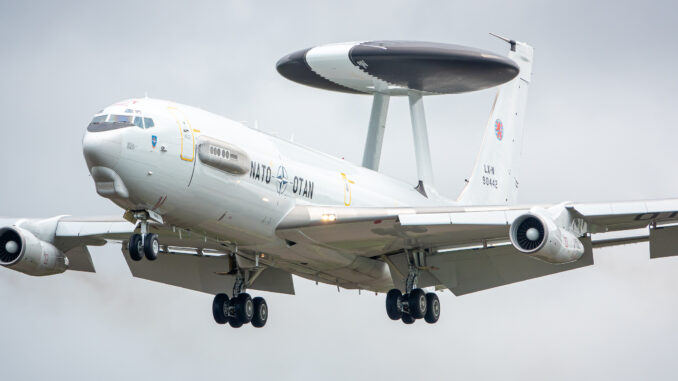
AviationNews – NATO has authorized the forward deployment of an Airborne Warning and Control System (AWACS) aircraft to Poland to tighten air surveillance along the alliance’s eastern flank. The move follows an airspace violation last week in which three Russian Kh-101 cruise missiles crossed into Polish territory and crashed.
The decision emerged from an extraordinary North Atlantic Council meeting held in Brussels on November 23 at Warsaw’s request, after Russian aerial weapons entered Polish airspace during a large-scale strike on neighboring Ukraine on November 20. Polish prosecutors later confirmed that wreckage recovered in the eastern Lublin region and southeastern Subcarpathian region belonged to three newly manufactured Russian Kh-101 cruise missiles. Following the emergency consultations, Supreme Allied Commander Europe Gen. Alexus Grynkewich ordered the deployment of the specialized radar plane to reinforce existing surveillance under NATO’s Eastern Sentry mission.
Operating from high altitude with a distinctive nine-meter-wide rotating radar dome, the NATO E-3A AWACS aircraft scans hundreds of kilometers of airspace to detect low-flying cruise missiles and aircraft well before they reach allied borders. Acting as an airborne command and control hub, the aircraft compiles a unified real-time radar picture and relays targeting data directly to allied fighter jets, warships, and ground-based air defense batteries. This expanded coverage significantly reduces reaction times for Polish and allied quick-reaction alert fighters patrolling the border.
“NATO and Allied assets reacted quickly to the airspace violations, and the Supreme Allied Commander Europe has authorized the forward deployment of a NATO Airborne Warning and Control System aircraft,” NATO spokesperson Allison Hart said in a statement. “All Allies stand in full solidarity with Poland. NATO remains united, ready, and committed to defending against any threat.”
Looking ahead, alliance military commanders are evaluating whether to deploy additional air defense assets to further bolster deterrence along NATO’s eastern frontier. Polish defense officials emphasized that the expanded radar presence is strictly defensive, aimed at improving situational awareness and preventing future spillover incidents from the war in Ukraine without escalating regional tensions.
NATO’s decision to forward-deploy an AWACS surveillance aircraft to Poland delivers a swift operational response to the November 20 Kh-101 cruise missile incursions. As allied commanders review broader eastern flank defenses, continuous airborne radar monitoring will play a vital role in safeguarding Polish airspace and maintaining deterrence across the region.