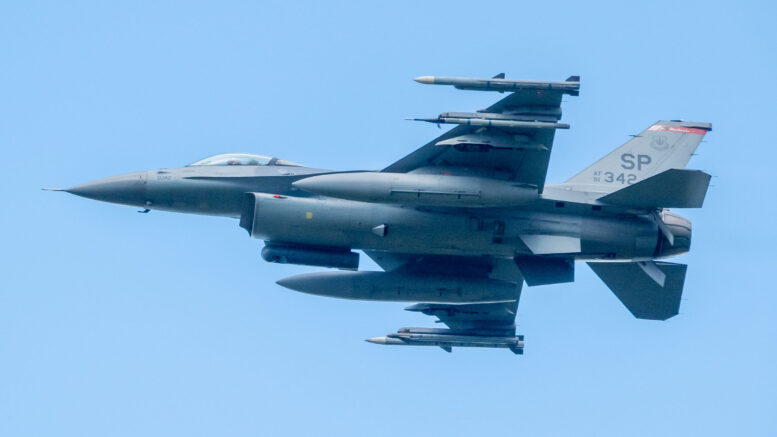
Aviation News – US Central Command refuted allegations from Iranian state media on Saturday that Iranian air defenses damaged an American F-16 fighter jet over the Persian Gulf, confirming that all military aircraft in the region remain completely safe.
The conflicting accounts emerged after Iranian state media and military officials reported that domestically developed air defense systems targeted an American fighter aircraft on Friday evening. According to Tehran’s version of events, a surface-to-air missile detonated near the jet while it operated near the Strait of Hormuz, allegedly forcing the pilot to abort the mission and execute an emergency landing at an unnamed regional airport.
The dispute unfolds amid heightened military tensions across the Middle East, where ongoing regional hostilities have frequently sparked competing narratives over aerial engagements and maritime security. Washington and Tehran have repeatedly clashed over the accuracy of battlefield reports, with American defense officials routinely countering claims of downed or damaged coalition aircraft. From an operational standpoint, integrated air defense networks rely on ground-based radar arrays to track high-speed targets like the F-16 Fighting Falcon, which utilizes advanced electronic countermeasures and threat-warning systems to evade radar locks. Had a proximity-fused missile detonated near an operational jet, flight telemetry and regional air traffic monitoring would register immediate distress signals and emergency diversions, neither of which occurred during Friday’s flight operations.
“Iran did not attack a US F-16 fighter aircraft yesterday — at all,” US Central Command stated in an official communication dismissing the report as false, adding that “all US military fighter jets in the Middle East are safe and accounted for”.


