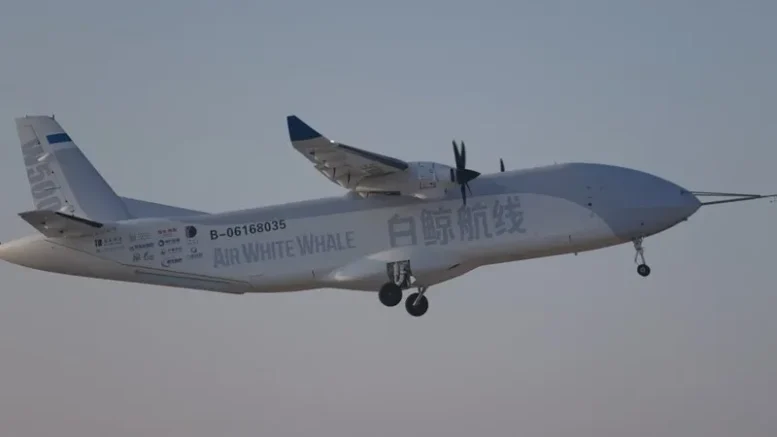
Aviation News – Chinese aircraft developer Air White Whale successfully completed the maiden test flight of its W5000 uncrewed cargo aircraft, marking a major milestone as the world’s largest uncrewed cargo aircraft. The historic test took place at Otog Front Banner General Aviation Airport in Inner Mongolia, showcasing autonomous aviation capabilities designed to transform logistics.
The W5000 completed a successful 30-minute test flight on Saturday, reaching an altitude of approximately 3,300 feet and maintaining an indicated airspeed of about 119 knots. Announced by China’s Changzhou municipal government on November 16, the flight evaluated critical system performances including propulsion, advanced avionics, flight-control software, and ground-monitoring telemetry. During the session, the twin-turboprop aircraft executed precise aerial maneuvers, including controlled climbs, steep turns, level cruising, descents, and standard landing approaches to verify structural and aerodynamic stability.
Engineered for heavy-lift commercial logistics, the twin-turboprop W5000 features a maximum takeoff weight of approximately 23,800 pounds and boasts an impressive payload capacity of up to 11,000 pounds. Its expansive cargo compartment provides more than 2,295 cubic feet of volume, fully capable of accommodating standard commercial aviation containers and pallets. With a reported maximum operating range of approximately 1,600 miles, the aircraft utilizes autonomous flight control systems managed under rigorous ground-based supervision to optimize supply chain efficiency.
Uncrewed large-scale cargo platforms operate by integrating redundant digital flight-control architecture with real-time satellite telemetry, allowing remote operators to oversee automated flight plans from takeoff to touchdown. The operational impact of this technology significantly reduces crew overhead, lowers per-ton freight costs, and opens up remote shipping lanes previously constrained by human pilot logistics. Technical relevance centers on adapting heavy-lift commercial airframes for uncrewed architectures, setting a new benchmark for autonomous civil aviation standards.