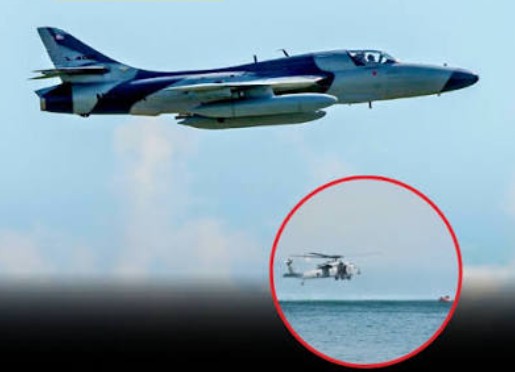
AviationNews – A vintage [Hawker Hunter] tactical jet operated by defense contractor [ATAC] plunged into the Pacific Ocean off the California coast on Tuesday night, prompting an immediate naval search-and-rescue operation. The pilot safely ejected from the aircraft roughly six miles northwest of Morro Bay and was swiftly recovered from the water by military rescue teams.
The downed aircraft, registered as N345AX, holds an iconic pedigree in modern aviation history, having previously achieved worldwide fame on the European display circuit under the civilian registration G-PSST and the moniker [Miss Demeanour]. Originally manufactured in the United Kingdom as an F.4 before being refurbished to Swiss Air Force Mk.58 specifications, the jet was later exported to North America and integrated into adversary air fleets in the [USA]. Staging out of Naval Base Ventura County at Point Mugu, the jet was conducting contracted adversary flight training over maritime ranges when an inflight emergency forced the pilot to abandon the aircraft, resulting in the offshore [crash].
The swept-wing Hawker Hunter Mk.58, powered by a Rolls-Royce Avon turbojet engine, serves as an economical and agile platform for commercial aggressor squadrons. Airborne Tactical Advantage Company deploys the transonic fighter to simulate hostile cruise missiles, strike aircraft, and dissimilar combat threats during joint exercises with frontline carrier strike groups and land-based squadrons. By absorbing demanding flight hours during mock aerial dogfights, contractor-owned legacy platforms provide combat-realistic readiness while preserving the service life of advanced fifth-generation fighters.
Highlighting the demanding training tasks assigned to the platform, ATAC emphasizes the airframe’s frontline utility: “The aircraft’s steady performance allows ATAC to use it as a transonic fighter in the air-to-air role, as a stable, precise platform in the air-to-surface role, and the aircraft is a versatile opponent in all fleet integrated training exercises. We firmly believe it is our mission to assist in training today’s warriors for tomorrow’s challenges.”
Federal aviation authorities alongside military safety investigators are reviewing flight data and maintenance logs to isolate the exact cause of the power-loss event. Meanwhile, maritime officials urge mariners operating in the waters northwest of Morro Bay to maintain sharp lookouts, exercise caution, and immediately alert the U.S. Coast Guard Sector Los Angeles-Long Beach should any floating debris or environmental hazards emerge.
The accident highlights the intense physical demands placed on vintage military platforms serving at the sharp end of commercial defense readiness. While aviation enthusiasts mourn the loss of one of the world’s most recognizable surviving Hunters, the prompt ejection and maritime recovery preserved the aviator’s life and affirmed the critical value of proven emergency egress equipment.