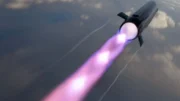
Aviation News – GE Aerospace has successfully tested a solid-fuel ramjet at supersonic speeds over Florida’s Kennedy Space Center, marking a milestone in its hypersonic propulsion program.
The flights were part of the company’s Atmospheric Test of Launched Airbreathing System (ATLAS) program, which aims to gather real-world data on how ramjets perform under flight conditions. Unlike wind tunnel experiments, the airborne tests capture the effects of aerodynamic loads, vibration, and heating. Results will help determine the viability of solid-fuel ramjets for future hypersonic weapons.
Mounted on an F-104 Starfighter research jet, the ramjet hardware completed three flights at supersonic speeds. The campaign provided engineers with crucial data on how the system behaves in realistic conditions, advancing efforts to make air-breathing propulsion a practical option for next-generation defense systems.
“This marks a pivotal moment for GE Aerospace as we showcase our solid-fuel ramjet technology in flight for the first time,” said Mark Rettig, Vice President and General Manager of Edison Works Business & Technology Development at GE Aerospace. “Testing reusable flight hardware in realistic atmospheric conditions allows us to better understand system behavior and move more quickly through development.”
Funded by the Pentagon under Title III of the Defense Production Act, ATLAS highlights Washington’s push to accelerate hypersonic technologies. GE has expanded its hypersonics portfolio in recent years, acquiring propulsion specialist Innoveering in 2022 and upgrading research facilities across Ohio and New York earlier in 2025.
By leveraging the supersonic capabilities of the F-104, operated by Starfighters Aerospace from Kennedy Space Center, GE combined cost efficiency with performance in testing. The flights underscore the role of industry-government collaboration in shaping the future of U.S. hypersonic capabilities.
Photo Rob Vogelaar